

Creating Military Power: The Sources of Military Effectiveness
페이지 정보
본문
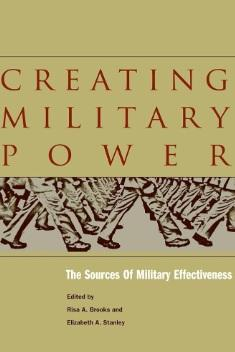
Risa A. Brooks & Elizabeth A. Stanley, Creating Military Power: The Sources of Military Effectiveness (Stanford University Press, 2009), pp.252.
Risa A. Brooks is Assistant Professor of Political Science at Northwestern University. Elizabeth A. Stanley is Assistant Professor in the Edmund A. Walsh School of Foreign Service and in the Department of Government at Georgetown University.
Creating Military Power examines how societies, cultures, political structures, and the global environment affect countries' military organizations. Unlike most analyses of countries' military power, which focus on material and basic resources—such as the size of populations, technological and industrial base, and GNP—this volume takes a more expansive view. The study's overarching argument is that states' global environments and the particularities of their cultures, social structures, and political institutions often affect how they organize and prepare for war, and ultimately impact their effectiveness in battle. The creation of military power is only partially dependent on states' basic material and human assets. Wealth, technology, and human capital certainly matter for a country's ability to create military power, but equally important are the ways a state uses those resources, and this often depends on the political and social environment in which military activity takes place.
"This book's sensible premise is that a state's military power―often measured by gross national product, industrial capacity, population size, number of troops, and arsenal―does not necessarily determine military effectiveness... [Creating Military Power] is an excellent set of essays that specialists on military-security issues will read with much profit."―CHOICE
"Rigorous social science too often treats military power as the epiphenomenon of economic or technological resources. This impressive volume helps rectify that common mistake. It explores and details how what really matters―the actual effectiveness of militaries―depends on complex social, political, diplomatic, and organizational underpinnings."―Richard K. Betts,Director, Saltzman Institute of War and Peace Studies, Columbia University
"Creating Military Power is creative and rigorous, attentive to historical detail, and concerned with policy implications. It will undoubtedly be read with great enthusiasm by specialists on international security in both the academy and think tanks."―Ronald R. Krebs, University of Minnesota
"Comprising a conceptual framework, seven substantive chapters, a critical individual synthesis reflecting on the book itself and a summary conclusion, this edited book provides a set of constructive conceptual and empirical contributions to international relations, political science, and military studies."―H-Net
Creating Military Power examines how societies, cultures, political structures, and the global environment affect countries' military organizations. Unlike most analyses of countries' military power, which focus on material and basic resources—such as the size of populations, technological and industrial base, and GNP—this volume takes a more expansive view. The study's overarching argument is that states' global environments and the particularities of their cultures, social structures, and political institutions often affect how they organize and prepare for war, and ultimately impact their effectiveness in battle. The creation of military power is only partially dependent on states' basic material and human assets. Wealth, technology, and human capital certainly matter for a country's ability to create military power, but equally important are the ways a state uses those resources, and this often depends on the political and social environment in which military activity takes place.
“Rigorous social science too often treats military power as the epiphenomenon of economic or technological resources. This impressive volume helps rectify that common mistake. It explores and details how what really matters—the actual effectiveness of militaries—depends on complex social, political, diplomatic, and organizational underpinnings.” --Richard K. Betts,Director, Saltzman Institute of War and Peace Studies, Columbia University
Creating Military Power is creative and rigorous, attentive to historical detail, and concerned with policy implications. It will undoubtedly be read with great enthusiasm by specialists on international security in both the academy and think tanks.”
—Ronald R. Krebs, University of Minnesota
Amazon.com: 군사력 창출: 군사 효과의 근원: 9780804753999: Brooks, Risa A.: 도서
-------------
‘군사력’을 만드는 눈에 보이지 않는 힘
현대 군사명저를 찾아서 >> 리사 브룩스와 엘리자베스 스탠리 『군사력 건설: 군사적 효과성의 원천』
글로벌파이어파워(GFP)라는 사이트는 매년 세계 군사력 순위를 발표한다. 여기서 한국은 세계 5위의 군사력을 보유한 나라로 소개된다. 이 주장은 사실일까? 여기서 중요한 것은 순위를 어떻게 산출하느냐에 있다. GFP는 일단 핵전력을 제외한 재래식 전력을 대상으로 한다. 측정 대상도 계량화할 수 있는 물질적 요소다. 무기와 병력을 중심으로 재정 규모나 도로와 항만 같은 사회간접자본에 의존한다. 그렇다면 이러한 군사력 순위는 얼마만큼 실제 군사력을 반영하는 것일까?
군사력의 본질적 기준
『군사력 건설: 군사적 효과성의 원천』의 저자 리사 브룩스와 엘리자베스 스탠리가 문제로 삼는 지점이 바로 이것이다. 실제 군사력의 본질적 기준은 무엇이며, 이러한 군사력은 어떻게 창출되는가 하는 점이다. ‘왜 어떤 국가는 동일한 자원을 가지고도 더 강한 군사력을 발휘하는가?’ 즉 ‘왜 어떤 군대는 제한된 자원에도 불구하고 전장에서 뛰어난 성과를 내는 반면 다른 군대는 풍부한 자원으로도 실패하는가?’란 질문은 군사력 논의에서 매우 중요한 의미를 갖는다. 왜냐하면 군사력은 국가권력의 핵심 요소며 국가 간 협상, 분쟁, 전쟁의 결과에 직접적인 영향을 미치기 때문이다.
댓글목록
등록된 댓글이 없습니다.